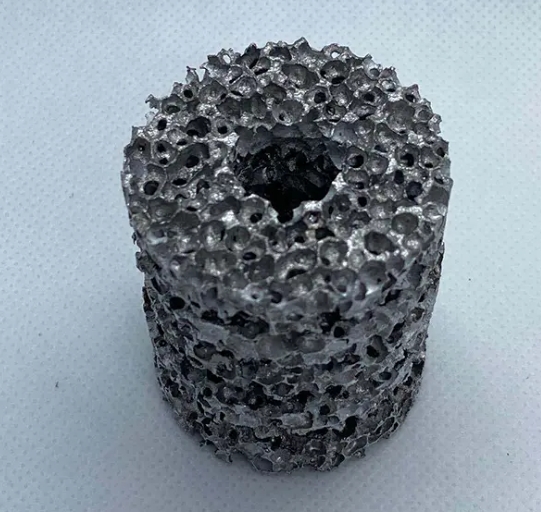
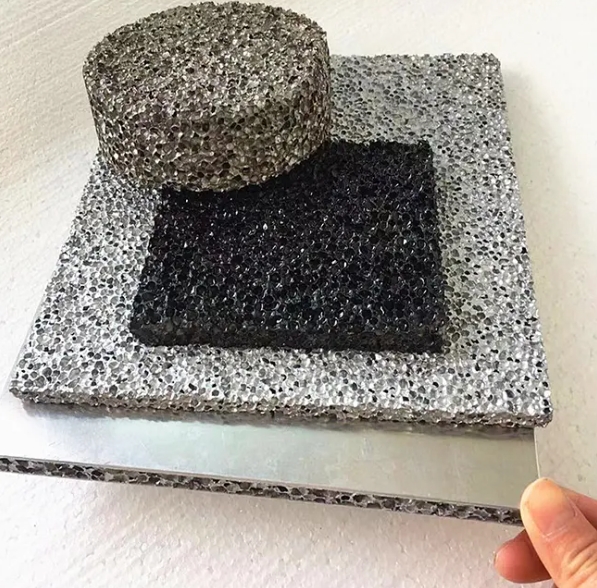
In the harsh and demanding environments of offshore platforms, materials face continuous exposure to saltwater, extreme temperatures, and intense mechanical stress. To meet these challenges, the offshore industry is increasingly turning to corrosion-resistant marine aluminum foam — an innovative material that offers a unique combination of strength, lightweight structure, and excellent resistance to marine corrosion.
Products Description

Aperture | 0.3mm-7mm(can customized) |
Porosity | 63%-90% |
The MAX Sound Absorption Coefficient | ≥0.8 |
Bulk density | 0.27-1.08 g/cm3 |
size | Customized |
What Is Marine Aluminum Foam?
Marine aluminum foam is a lightweight metallic material composed of aluminum with a porous structure. The foam is manufactured through advanced techniques such as direct foaming of molten aluminum or powder metallurgy. These processes result in a uniform structure of interconnected pores that provide high mechanical strength, energy absorption, and outstanding corrosion resistance — making it ideal for maritime applications.
Applications in Offshore Platforms
1. Structural Reinforcement
Marine aluminum foam is used as a core material in sandwich panels for platforms, walkways, and structural frames. Its light weight reduces the overall load on the platform, while its strength ensures safety and durability even under dynamic loading from waves and wind.
2. Buoyancy Modules
The closed-cell structure of aluminum foam allows it to function as an effective buoyant material for subsea applications. It can support floating structures, risers, and other submerged components, providing both buoyancy and structural integrity.
3. Fireproof and Corrosion-Resistant Cladding
Aluminum foam panels serve as fire-resistant cladding materials that also resist marine corrosion. They protect internal components from saltwater exposure while also serving as thermal and acoustic insulators.
4. Vibration Damping and Noise Reduction
Due to its cellular structure, aluminum foam absorbs vibrations and sound waves, which is especially beneficial in offshore environments where constant machinery operation and ocean impact generate high levels of noise and vibration.
User Needs and Industry Requirements
Offshore operators and engineers prioritize materials that:
Withstand saltwater corrosion over long periods
Offer lightweight alternatives to traditional steel structures
Provide fire resistance and thermal insulation
Support modular and prefabricated designs to reduce installation time
Require low maintenance and have a long service life in aggressive marine conditions
Marine aluminum foam fulfills all of these needs. Its inherent corrosion resistance reduces the need for coatings or frequent replacements, which directly translates to lower maintenance costs and improved operational uptime.
Advantages of Marine Aluminum Foam
Corrosion Resistance: Naturally forms a protective oxide layer that resists saltwater-induced degradation
Weight Reduction: Up to 70–90% lighter than solid metal components, easing load on structures
High Energy Absorption: Ideal for impact protection and dynamic load buffering
Eco-Friendly: Fully recyclable and supports sustainable offshore construction
Customizable: Can be engineered in various pore sizes, shapes, and configurations to suit specific applications
Industry Trends and Outlook
The global push for sustainable and safer offshore operations is accelerating the adoption of advanced materials like aluminum foam. Innovations in 3D printing and hybrid composite designs are opening up even more applications for this versatile material in floating wind farms, deep-sea mining structures, and next-generation oil platforms.
As the offshore industry moves toward lighter, more modular, and corrosion-resistant infrastructure, marine aluminum foam is becoming a preferred solution for future-ready platform design.