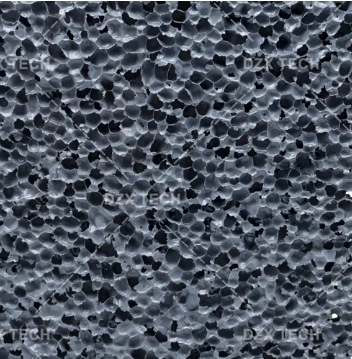
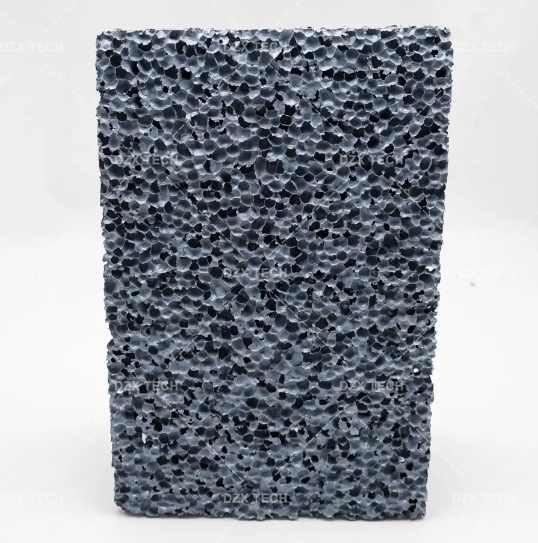
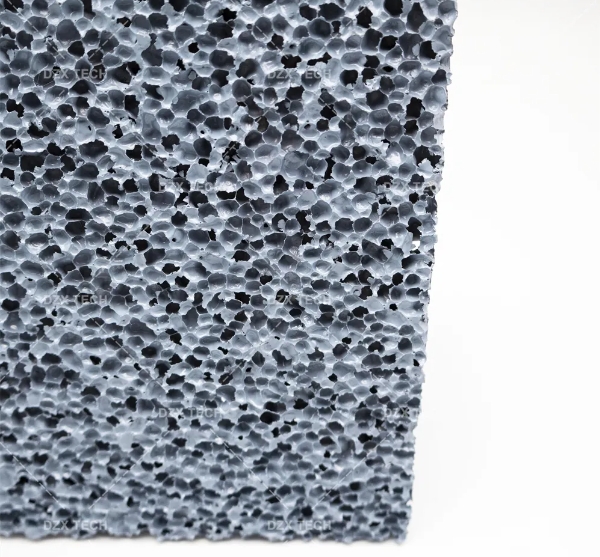
In the aerospace industry, the demand for stronger, lighter, and more energy-efficient materials continues to grow as manufacturers strive to improve fuel efficiency, structural integrity, and overall performance. One of the most advanced solutions to meet these challenges is the lightweight aluminum foam core, particularly when used in aerospace sandwich structures.
What Is an Aluminum Foam Core?
Aluminum foam is a highly porous metal created by introducing gas or a foaming agent into molten aluminum. The result is a lightweight material with a cellular structure that maintains a balance of low density and mechanical strength. When used as a core material between two face sheets—often in aluminum, titanium, or composite materials—it forms a sandwich panel with exceptional structural and functional properties.
Products Description

Aperture | 0.3mm-7mm(can customized) |
Porosity | 63%-90% |
The MAX Sound Absorption Coefficient | ≥0.8 |
Bulk density | 0.27-1.08 g/cm3 |
size | Customized |
Why Use Aluminum Foam in Aerospace Sandwich Structures?
Aerospace sandwich structures are designed to maximize stiffness while minimizing weight, making them ideal for use in:
Aircraft fuselage and wing components
Satellite panels and structural elements
Helicopter rotor blades and drone frames
Engine nacelles and fairings
By integrating aluminum foam as the core, these sandwich panels offer a range of critical benefits:
Key Advantages of Aluminum Foam Core in Aerospace
Ultra-Lightweight with High Stiffness
The foam’s cellular structure significantly reduces weight without sacrificing stiffness. This helps to lower the overall mass of aerospace components, directly improving fuel efficiency and payload capacity.
Excellent Energy Absorption
Aluminum foam exhibits superior impact resistance and shock absorption, making it ideal for areas of the aircraft subject to dynamic loads or potential collisions.
Superior Thermal and Fire Resistance
Unlike polymer-based core materials, aluminum foam is non-flammable and performs reliably under extreme temperature variations, which is essential for both atmospheric and space applications.
Acoustic Damping and Vibration Reduction
The porous structure dampens vibrations and reduces noise transmission, contributing to a quieter, more comfortable in-flight environment.
Corrosion Resistance and Long-Term Durability
Aluminum naturally resists oxidation and corrosion, especially when anodized or coated, ensuring a long service life in harsh aerospace environments.
Addressing Aerospace Industry Needs
Modern aerospace design faces increasing demands for:
Weight reduction without compromising strength
Material reliability under high stress and temperature extremes
Sustainability, through recyclable and energy-efficient materials
Manufacturing efficiency, including compatibility with automated processes