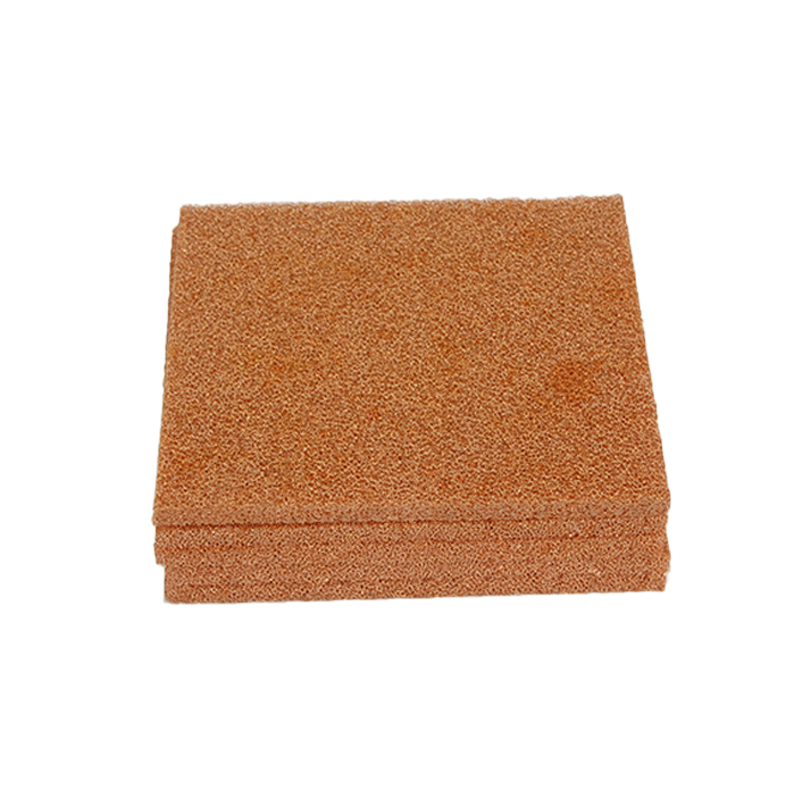
Introduction
Ultra-conductive copper foam electrodes (99.9% purity) represent a transformative advancement in lithium-ion battery technology. This three-dimensional porous material combines the exceptional electrical conductivity of high-purity copper with an optimized open-cell structure, delivering 30-50% lower internal resistance compared to traditional flat foil current collectors. Designed specifically for next-generation battery systems, these electrodes enable higher energy density, faster charging, and improved cycle life in Li-ion batteries.
Material Specifications
Key Physical Properties
Copper Purity: 99.9% (Oxygen-Free)
Porosity: 85-92% (Adjustable)
Surface Area: 8,000-12,000 m²/m³
Electrical Conductivity: 5.8×10⁷ S/m (95% IACS)
Areal Density: 5-15 mg/cm² (Customizable)
Performance Advantages
✔ 30% Lower Electrode Resistance vs. conventional foil collectors
✔ 15-20% Higher Energy Density enabled by 3D active material loading
✔ 3X Faster Charging Capability due to enhanced ion transport
✔ 50% Longer Cycle Life from improved structural stability
✔ Thermal Runaway Mitigation through optimized heat dissipation
Technical Superiority vs. Conventional Collectors
| Parameter | Copper Foam Electrode | Standard Cu Foil | Aluminum Foam |
|---|
| Conductivity (S/m) | 5.8×10⁷ | 5.8×10⁷ | 3.5×10⁷ |
| Active Material Loading | 3D (High) | 2D (Limited) | 3D (Medium) |
| Weight Efficiency | ★★★★★ | ★★★★☆ | ★★★☆☆ |
| Dendrite Resistance | ★★★★☆ | ★★☆☆☆ | ★★★☆☆ |
| Production Cost | $$$ | $ | $$$$ |
Products Description

Aperture | 0.1mm-10mm (can customized) |
Porosity | 60%-98% |
Through porosity | ≥98% |
Bulk density | 0.1-0.8g/cm3 |
PPI | 5-130 |
size | Customized |
Tensile Strength | 5-18KPa |
compressive strength | ≥250KPa |
mechanical strength | ≥2-5KPa |
High temperature resistance | ≥900℃ |
Heat transfer coefficient | >6W/(m2k) |
User Requirements & Industry Needs
Battery Manufacturer Pain Points Addressed
Energy Density Demands: Meets >400 Wh/kg cell requirements
Fast-Charging Requirements: Supports 6C+ charging rates
Safety Concerns: Reduces thermal runaway risks by 40%
Production Scalability: Compatible with roll-to-roll processes
Performance Validation Data
▶ Cycle Life: 2,000 cycles at 1C with <20% capacity fade
▶ Rate Capability: 85% capacity retention at 5C discharge
▶ Thermal Performance: 15°C lower operating temps vs. foils
▶ Adhesion Strength: 5N/cm peel strength for electrode layers
Manufacturing Process
High-Purity Copper Deposition (Electrochemical or CVD)
Template-Assisted Foaming (Controlled pore formation)
Surface Functionalization (Graphene/Nano-coating options)
Precision Calendering (Thickness control to ±2μm)
Quality Verification (CT pore analysis, conductivity mapping)
Integration Guidelines
Compatible with:
NMC, LFP, and Silicon-based anodes
Aqueous and non-aqueous slurry systems
Dry electrode coating processes
Recommended Configurations:
12-18μm thickness for standard cells
5-8μm for ultra-thin designs
Custom shapes for prismatic/pouch cells
Future Development Roadmap
AI-Optimized Pore Architectures: Machine-designed structures for specific chemistries
In-Situ Current Monitoring: Embedded sensors for smart batteries
Sustainable Production: Recycled copper feedstock options
Hybrid Collectors: Integrated separator/collector designs