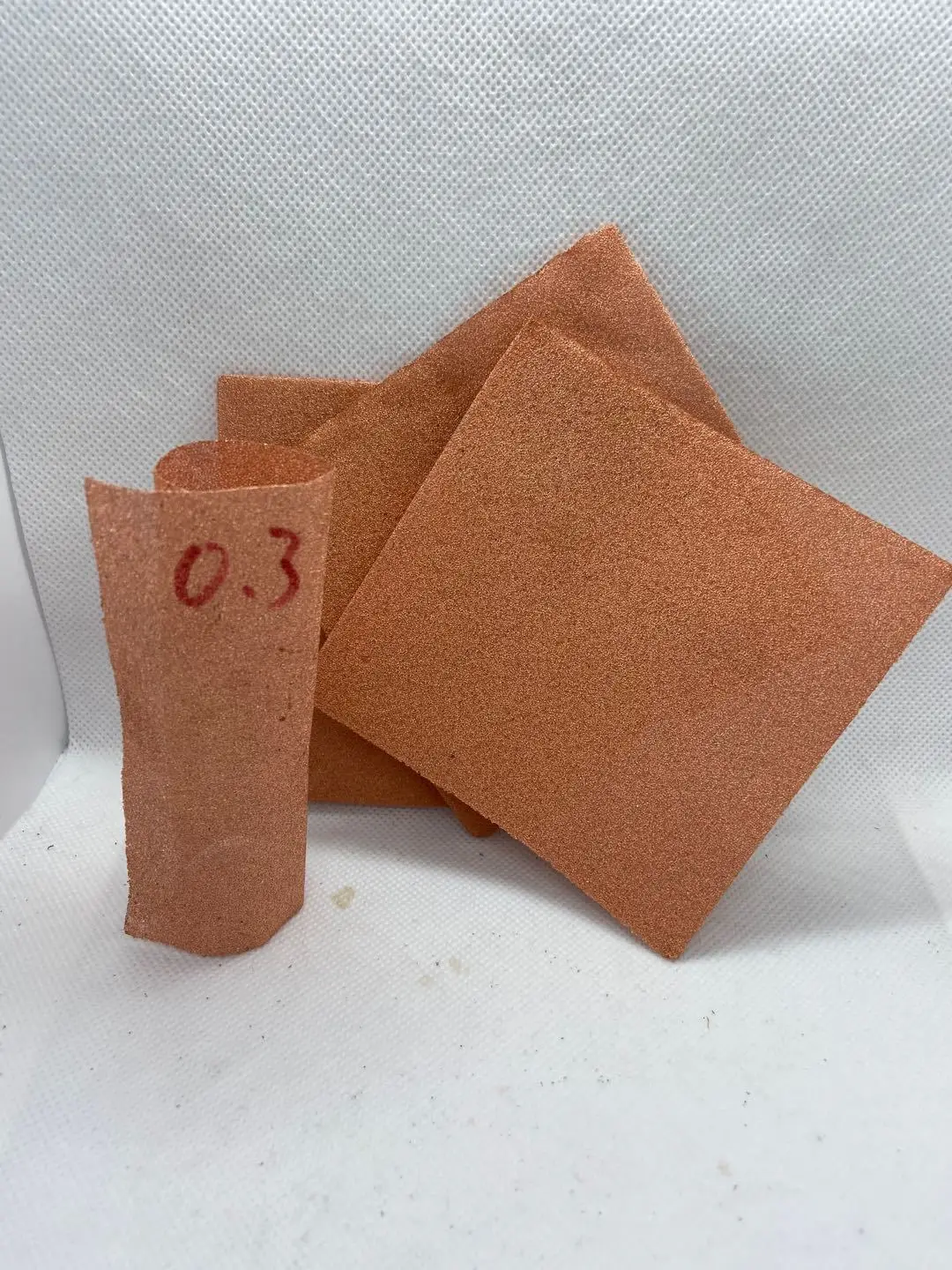
High-porosity copper foam (95%) represents a breakthrough in thermal management solutions, offering an exceptional combination of ultra-lightweight structure and superior heat dissipation for modern electronics. This advanced material's unique open-cell architecture provides 15,000 m²/m³ surface area in a structure that's 90% lighter than solid copper, making it ideal for applications where weight reduction and thermal performance are critical.
Products Description

Aperture | 0.1mm-10mm (can customized) |
Porosity | 60%-98% |
Through porosity | ≥98% |
Bulk density | 0.1-0.8g/cm3 |
PPI | 5-130 |
size | Customized |
Tensile Strength | 5-18KPa |
compressive strength | ≥250KPa |
mechanical strength | ≥2-5KPa |
High temperature resistance | ≥900℃ |
Heat transfer coefficient | >6W/(m2k) |
Material Characteristics
Key Physical Properties
Porosity: 95% (±2%)
Density: 0.25-0.35 g/cm³
Pore Size: 500-800 μm (adjustable)
Thermal Conductivity: 80-120 W/m·K
Compressive Strength: 3-5 MPa
Performance Advantages
✔ 3X Better Heat Dissipation than conventional finned heat sinks
✔ 90% Weight Reduction compared to solid copper solutions
✔ Omnidirectional Cooling through 3D interconnected pores
✔ Customizable Shapes for complex electronic layouts
✔ Vibration Damping for sensitive components
Primary Applications
1. High-Power Electronics Cooling
CPU/GPU Thermal Management:
Reduces hotspot temperatures by 15-20°C in processors
Enables higher clock speeds without throttling
Power Electronics:
IGBT modules in EVs
Server power supplies
Industrial motor drives
2. Electric Vehicle Systems
Battery Thermal Regulation:
Maintains optimal 25-35°C range for Li-ion cells
40% lighter than aluminum cooling plates
Onboard Charger Cooling:
Handles 10-20 kW heat loads in compact spaces
3. LED and Optoelectronics
High-Brightness LED Arrays:
Extends lumen maintenance by 30%
Prevents color shift in high-CRI LEDs
Laser Diode Cooling:
Stable operation for fiber lasers
Compact packaging for medical lasers
4. Aerospace Electronics
Avionics Thermal Control:
Withstands vibration and thermal cycling
60% weight savings over traditional solutions
Satellite Systems:
Passive cooling in vacuum environments
Radiation-resistant material properties
User Requirements & Market Needs
Industry Pain Points Addressed
Electronics Manufacturers:
Need compact cooling for increasingly powerful chips
Require lighter solutions for portable devices
Automotive Tier 1 Suppliers:
Seek reliable thermal management for 800V EV systems
Demand materials surviving 15+ year service life
Aerospace Engineers:
Require lightweight solutions with 10G vibration resistance
Need materials passing NASA outgassing tests
Performance Expectations
▶ Temperature Reduction: Minimum 15°C drop vs. conventional heatsinks
▶ Reliability: 50,000+ thermal cycles without degradation
▶ Ease of Integration: Simple bonding to PCBs and components
▶ Cost-Effectiveness: 20-30% cheaper than vapor chambers