Product Introduction
Our anti oxidation bright nickel coated copper strip, also named battery conductive belt, is independently developed and manufactured by DZX specifically for lithium battery connection structures and power conductive terminals. We use premium T2 oxygen-free copper as the base material, matched with our self-developed mirror-bright continuous nickel electroplating process. Unlike dull electroplated products flooding the market, our coating forms a glossy, pore-free uniform protective layer that tightly bonds with copper without flaking after bending, stamping or long-term high-current operation.
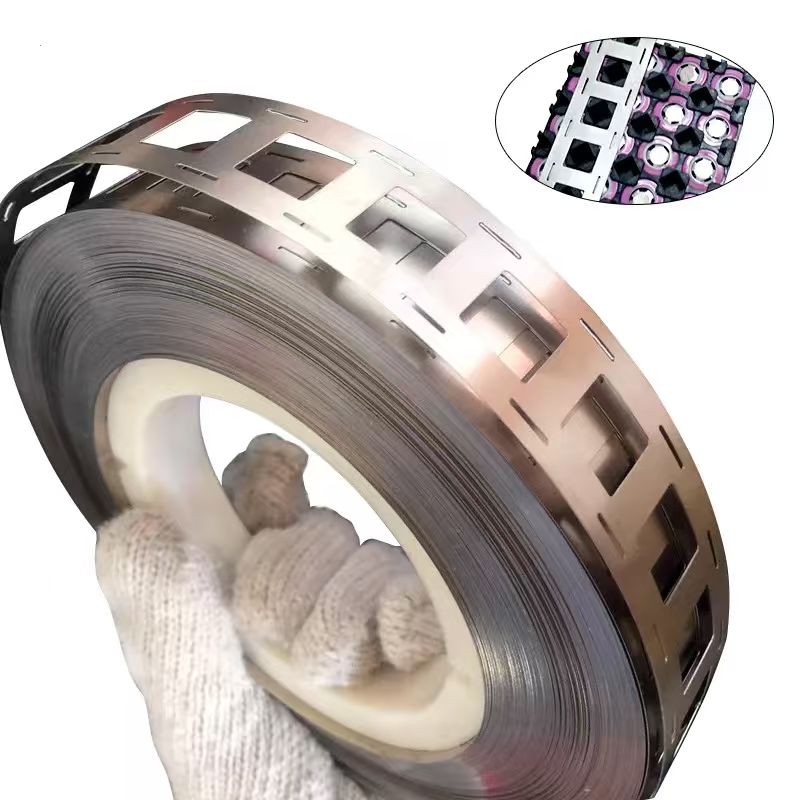
The core value of this composite material lies in breaking the performance trade-off between conductivity and oxidation resistance. Pure copper conductive belts oxidize rapidly in damp battery workshop environments, creating high contact resistance that triggers overheating risks during battery charging and discharging. Single nickel strips cut down oxidation issues drastically but carry terrible electrical conductivity, leading to massive energy loss for battery packs. DZX’s bright nickel coated copper belt fixes both defects at once. The copper core retains outstanding electrical transmission efficiency, while the dense bright nickel coating blocks oxygen, moisture and trace electrolyte corrosion inside battery modules.
We run full closed-loop production from copper slab rolling, surface activation polishing, low-stress bright nickel plating, precision annealing to slitting. Every batch undergoes 100% offline performance testing before shipment. Our finished conductive belts meet RoHS, REACH and new energy industry safety standards, free of harmful impurities that cause battery short-circuit failures. The bright plating surface also brings an extra benefit: it improves automatic visual inspection efficiency for battery manufacturers, cutting manual sorting labor costs during mass assembly. We control every production link internally instead of outsourcing plating work, so every physical and electrical parameter stays consistent across thousands of production rolls.
Application Scenarios & Industry Trends
This anti oxidation bright nickel coated copper conductive belt dominates the new energy battery supply chain, covering three core high-growth application areas.
First, lithium energy storage battery modules. Energy storage cabinets operate outdoors with large temperature swings and high humidity. Battery connecting belts need stable low resistance and long-term anti-rust performance to guarantee decades of safe power transmission, a requirement ordinary bare copper belts cannot satisfy.
Second, new energy vehicle power batteries. EV battery packs carry continuous high discharge current during driving. Our conductive belts serve as internal bus connectors, cell linking tabs and wiring harness terminals, enduring vibration, heat cycling and minor electrolyte volatilization inside sealed battery cases.
Third, portable energy storage & consumer battery packs. Power stations, two-wheeler lithium batteries and household backup batteries adopt miniaturized conductive belts. The bright nickel surface supports smooth automated spot welding and tight bending for compact battery structural design.
Looking at overall industry trends, the global lithium battery market maintains steady expansion. Manufacturers are shifting away from cheap bare copper belts to composite coated conductive materials to reduce after-sales battery failure rates. Industry data shows demand for anti-oxidation coated copper battery belts rises 13.2% year-on-year, driven by stricter safety standards for energy storage and automotive batteries. Low-performance uncoated copper materials will gradually be phased out of mid and high-end battery production lines in the next five years.
Real-World Pain Points of Ordinary Battery Conductive Belts
We have collected thousands of real feedback from battery production partners, summing up five recurring quality problems caused by standard uncoated or poorly plated conductive belts.
Fast surface oxidation of bare copper belts. After one month of storage or short-term operation in humid battery workshops, black copper oxide covers the surface. Contact resistance surges sharply, leading to abnormal temperature rise and even thermal runaway risks for battery packs under heavy load.
Matte, uneven plating on low-cost coated belts. Cheap batch plating leaves pinholes and thin coating spots. Electrolyte vapor penetrates the copper base, triggering hidden corrosion that breaks battery connections after several thousand charge-discharge cycles.
Coating peeling during stamping and bending. Suppliers skipping pre-plating surface activation produce belts whose nickel layers peel easily after folding. Exposed copper oxidizes quickly and ruins welding joints during battery assembly.
Low conductivity of pure nickel belts. Pure nickel conductive belts only deliver around 22% IACS conductivity. They generate severe heat under large current, limiting use in high-capacity energy storage and vehicle batteries.
Unstable batch consistency from small-scale processors. Discontinuous electroplating lines create huge gaps in coating thickness between batches. Battery factories must constantly adjust welding machine parameters, raising production scrap rates and testing expenses.
All these troubles disappear once factories switch to DZX anti oxidation bright nickel coated copper conductive belts, as we lock all key material indicators within ultra-narrow tolerance ranges through real-time production monitoring.
Core Parameter Explanation
We break down key technical metrics that directly affect battery safety and production efficiency for battery design engineers.
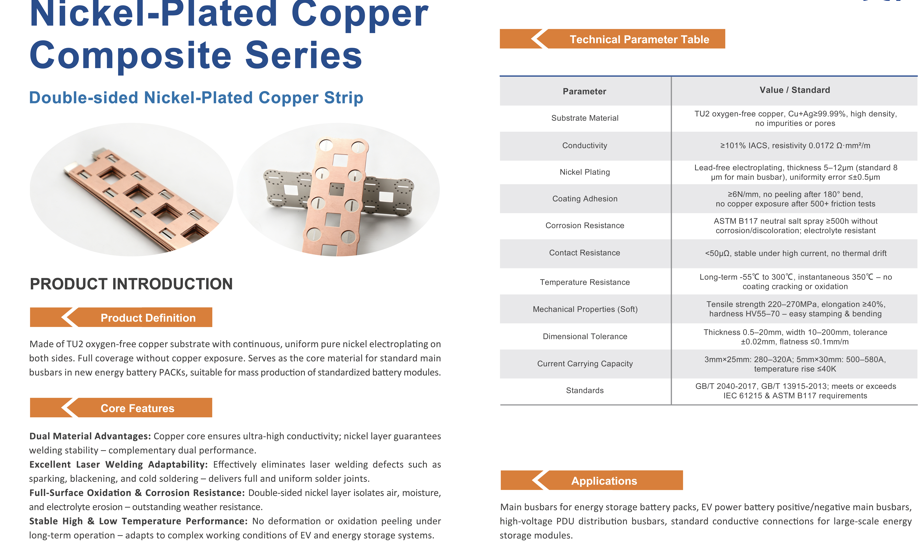
IACS Conductivity: International Annealed Copper Standard. Our belts hit 94–96% IACS, nearly matching pure copper, which minimizes heat generation during battery discharge.
Bright Nickel Coating Thickness: Adjustable from 1μm to 8μm; 3μm is standard for consumer batteries, 5μm recommended for vehicle and outdoor energy storage batteries. Too thin coating fails anti-corrosion tests, while over-thick nickel increases overall resistance and weakens welding stability.
Elongation & Temper: Soft annealed material reaches over 30% elongation, ideal for deep bending compact battery tabs; hard temper versions with 410–500MPa tensile strength fit fixed rigid busbar connections.
Neutral Salt Spray Resistance: Standard products pass 72-hour salt spray testing without corrosion marks; customized automotive grades support 200-hour salt fog performance.
Copper Base Purity: T2 oxygen-free copper with copper content ≥99.90%, few metallic impurities to avoid local hot spots under high current.
Dimensional Tolerance: Thickness tolerance ±0.003mm, width tolerance ±0.02mm, burr-free slitting to avoid puncturing battery cell diaphragms during assembly.
5. Material Performance Comparison Table
| Performance Index | DZX Anti Oxidation Bright Nickel Coated Copper Strip | Bare T2 Copper Belt | Regular Dull Nickel Plated Copper Belt | Pure Nickel Conductive Belt |
|---|
| IACS Conductivity | 95% | 100% | 93% | 22% |
| 48h Neutral Salt Spray Result | Zero corrosion spots | Heavy oxidation tarnish | Local rust pinholes | No surface corrosion |
| Monthly Contact Resistance Drift (70%RH environment) | +0.01mΩ | +0.23mΩ | +0.09mΩ | +0.004mΩ |
| Continuous Spot Welding Stability (10,000 cycles) | Smooth welds, no cracking | Oxide blocks welding joints | Uneven welding fusion | High energy input required |
| Max Continuous Current (0.3mm×12mm belt) | 68A | 71A | 62A | 24A |
| 20 Times 90° Bend Anti-Peel Test | Zero nickel coating shedding | No coating layer | Partial coating flaking | No coating layer |
| Long-Term Safe Working Temperature | 260℃ | 180℃ | 170℃ | 300℃ |
| Main Applicable Battery Grade | EV & energy storage high-end packs | Disposable low-power batteries | Ordinary two-wheeler lithium packs | Micro low-current battery tabs |
DZX Supplier Advantage Comparison
Compared with generic third-party material processors in the industry, DZX holds unique full-chain strengths for battery conductive belt clients, with no reference to competing brand names.
Independent full-process production lines & in-house R&D lab: We operate 7 continuous bright nickel plating production lines and own multiple composite conductive material patents. Most rival factories outsource plating procedures and cannot tweak coating formulas to match unique battery operating conditions. Our technical team optimizes coating brightness, stress and copper hardness based on customer battery drawings within three working days.
Complete industry certification portfolio: We hold IATF 16949, ISO9001, ISO14001, RoHS and REACH certifications, and provide full SGS test reports for every shipment. Small-scale processors rarely own vehicle-grade certification required by EV battery manufacturers.
Strict real-time batch consistency control: Optical thickness detectors run on all production lines for 24-hour automatic sampling inspection. Generic factories rely on manual random sampling, leading to coating thickness fluctuations exceeding ±1μm between batches and extra production losses for battery manufacturers.
Flexible low-MOQ customization: We support single-sided nickel coating, partial masking plating, custom width/thickness rolls and tailored temper levels, with trial order MOQ starting at 50kg. Ordinary suppliers only stock fixed standard sizes with minimum orders above 500kg.
Specialized new energy material technical service: Our sales and engineering teams all have lithium battery material expertise, offering free material selection advice during battery design stages. Most material vendors only deliver finished goods without downstream technical guidance.
Stable sufficient supply capacity: Our monthly production output hits 170 tons, with large reserves of T2 copper raw materials to prevent delivery delays caused by copper price volatility and supply shortages, a common issue for small manufacturers with limited capital.
8 Core FAQs with Full Answers
FAQ 1: What nickel coating thickness works best for lithium battery conductive belts?
3μm bright nickel coating balances cost and performance for portable batteries and two-wheeler lithium packs. EV and outdoor energy storage battery modules require 5μm thickness for long-term salt fog and electrolyte vapor resistance. Our engineers will suggest the optimal thickness after analyzing your battery’s service environment.
FAQ 2: Will DZX bright nickel coated copper belts interfere with battery spot welding equipment?
No. Our low-stress bright nickel layer forms a thin conductive interface during welding pulses, forming tight copper-nickel fusion joints without adjusting machine power. Mass production clients report a 4% rise in welding yield compared with generic coated belts.
FAQ 3: Can this conductive belt be folded and stamped into tiny battery tabs without coating peeling?
Absolutely. Pre-plating surface micro-etching and low-temperature annealing strengthen metallurgical bonding between nickel and copper. After 50 repeated 90-degree bending tests, no coating falls off, perfectly fitting automated stamping for thin mini battery tabs under 0.5mm thickness.
FAQ 4: How long can DZX battery conductive belts be stored before assembly without oxidation?
Our sealed anti-rust packaging supports six months of indoor storage with zero surface oxidation, far better than bare copper’s two-week storage limit. We offer vacuum anti-corrosion packaging as an extra option for factories located in coastal high-humidity zones.
FAQ 5: Do DZX conductive belts meet automotive power battery industrial standards?
All core specifications comply with IATF 16949 automotive standards, passing 200-hour salt fog, thermal cycle and vibration aging testing. We maintain stable mass supply for multiple first-tier EV battery manufacturers.
FAQ 6: Can we customize exclusive sizes, hardness or partial masking nickel coating for our proprietary battery products?
Full customization is available. We adjust copper base thickness (0.05–5mm), width (5–350mm), soft/hard temper, single-sided plating and fixed-length pre-cut rolls following customer technical drawings, with low trial order minimum quantity.
FAQ 7: How big is the conductivity gap between DZX coated belts and pure bare copper?
Our finished belts achieve 94–96% IACS conductivity, only 4–6% lower than bare copper. In actual battery high-current discharge testing, the temperature rise gap stays below 3℃ under equal load, while anti-oxidation lifespan increases more than ten times.
FAQ 8: What testing support does DZX provide after clients receive shipments?
We attach free third-party SGS inspection reports to every delivery batch. If quality doubts emerge, we offer complimentary lab testing for conductivity, coating thickness, salt fog resistance and tensile strength on incoming materials.
Closing Paragraph
Anti oxidation bright nickel coated copper conductive belts have become standard matching materials for mid and high-end lithium battery production. Still, numerous battery manufacturers struggle with unstable material quality, shortened battery service life and high assembly scrap rates when cooperating with regular material suppliers. As a professional composite conductive belt manufacturer with independent R&D and full production control, DZX solves all material matching pain points for battery producers, covering prototype trial production to consistent mass delivery.
We can provide customized one-stop conductive belt solutions, including bright nickel coating formula optimization, dimensional specification adjustment, temper matching and dedicated anti-rust packaging design, fully aligned with your battery structure design, assembly equipment parameters and long-term safety reliability standards. Our technical team completes free material performance simulation verification before sending formal samples, helping you lower battery failure risks and cut overall manufacturing costs. Send over your battery drawings and operating condition data to our team for personalized material recommendations and sample support.


