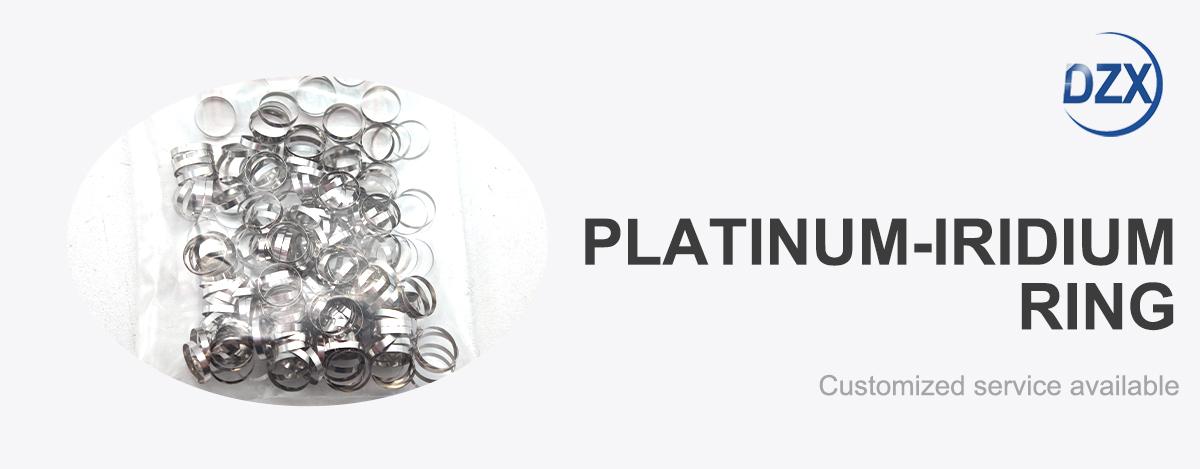
In the world of precision instruments, even the smallest components can make a massive difference. Platinum Iridium (Pt-Ir) alloy rings have become essential in scientific equipment that demands exceptional stability, corrosion resistance, and mechanical strength. At DZX, we specialize in manufacturing high-quality Pt-Ir alloy rings designed for laboratories, analytical devices, and scientific instruments that require uncompromising accuracy and longevity.
Material Analysis
Platinum Iridium alloys are a blend of platinum’s chemical inertness and iridium’s mechanical strength. This combination produces a material that is both highly durable and exceptionally stable. The most common compositions used in precision instruments are Pt-Ir 90/10 and Pt-Ir 80/20, offering an ideal balance between toughness and workability.
Platinum (Pt) provides excellent corrosion and oxidation resistance, even under exposure to acids and high temperatures.
Iridium (Ir) adds hardness, wear resistance, and enhances mechanical strength without sacrificing conductivity or stability.
Typical international equivalents include:
United States (ASTM F560) – Medical and scientific-grade platinum-iridium alloys.
Germany (DIN 17745) – Technical-grade Pt-Ir materials.
Russia (PtIr10, PtIr20) – High-purity industrial-grade alloys used in scientific instruments.
At DZX, all Pt-Ir materials are sourced and refined to maintain precise chemical consistency, ensuring each ring meets demanding laboratory and metrology standards.
Comparison Table: DZX Pt-Ir Alloy Rings vs. Common Laboratory Metals
| Property | DZX Pt-Ir Alloy Rings | Stainless Steel 316L | Tungsten | Titanium Alloy |
|---|
| Composition | Pt-Ir 90/10 or 80/20 | Fe-Cr-Ni | W | Ti-6Al-4V |
| Melting Point (°C) | 1800–1850 | ~1400 | ~3420 | ~1660 |
| Corrosion Resistance | Excellent | Moderate | Poor in acids | Very Good |
| Hardness (HV) | 220–260 | 200 | 350 | 340 |
| Conductivity | High | Low | Moderate | Low |
| Thermal Stability | Up to 1000°C | 500°C | 800°C | 600°C |
| Magnetic Properties | Non-magnetic | Slightly magnetic | Non-magnetic | Non-magnetic |
| Dimensional Stability | Excellent | Moderate | Good | Good |
| Service Life | 5–10x longer | Standard | Long but brittle | Long |
At DZX, we don’t just manufacture alloys — we engineer precision. Our Platinum Iridium Alloy Rings are produced using state-of-the-art vacuum melting and CNC machining processes that ensure exceptional purity and uniformity.
Our advantage lies in three key areas:
Material Integrity: DZX only uses high-purity platinum and iridium, ensuring stable alloy ratios and minimal inclusions.
Advanced Machining: Every ring undergoes precision forming, polishing, and dimensional verification to meet sub-micron accuracy standards.
Custom Engineering: DZX’s team works directly with research institutions and instrument manufacturers to tailor products for unique performance needs.
DZX’s production process is ISO-certified and traceable from raw material to final delivery. Whether for mass production or experimental prototypes, we maintain the same commitment to precision and reliability.
Our rings are not just components — they are part of a larger system of accuracy and trust built into scientific instruments worldwide. With decades of metallurgical expertise and cutting-edge production technology, DZX continues to push the boundaries of performance for platinum-based materials.
Conclusion
As the demand for scientific precision grows, the need for dependable materials becomes even more critical. Platinum Iridium Alloy Rings from DZX represent the perfect combination of strength, stability, and accuracy. Whether used in analytical balances, spectrometers, or laboratory reactors, these rings deliver long-term reliability that supports research and innovation.
With DZX, clients receive more than a product — they gain a partner committed to quality, innovation, and precision. Our Pt-Ir rings are a testament to how advanced materials and expert craftsmanship can empower the scientific community to reach new levels of excellence.


About Us:
Our 12,000㎡ factory is equipped with complete capabilities for research, production, testing, and packaging. We strictly adhere to ISO 9001 standards in our production processes, with an annual output of 1,200 tons. This ensures that we meet both quantity and quality demands. Furthermore, all products undergo rigorous simulated environment testing including high temperature, high pressure, and corrosion tests before being dispatched, ensuring they meet customer specifications. For all our clients, we offer timely and multilingual after-sales support and technical consulting, helping you resolve any issues swiftly and efficiently.

Client Visits
Building Stronger Partnerships

We support all kinds of testing:


What makes Pt-Ir rings ideal for scientific instruments?
They combine high strength, corrosion resistance, and stability, ensuring precise and consistent performance in analytical devices.
Which alloy compositions are most common?
Pt-Ir 90/10 and 80/20 are the most used ratios, offering an excellent balance between durability and workability.
Can DZX customize the size and composition?
Yes, DZX provides custom fabrication based on specific instrument designs, tolerances, and performance requirements.
Are Pt-Ir rings suitable for high-temperature applications?
Absolutely. They maintain stability up to 1000°C, ideal for instruments exposed to heat and chemical stress.
How do Pt-Ir rings resist corrosion?
Platinum’s noble characteristics and iridium’s chemical stability make the alloy virtually immune to acids and oxidation.
What precision level can DZX achieve?
DZX manufactures Pt-Ir rings with tolerances as fine as ±0.002 mm, ideal for high-accuracy scientific applications.
Do Pt-Ir rings require maintenance?
Minimal. Their wear and corrosion resistance significantly reduce replacement frequency.
How does DZX ensure product consistency?
Every batch undergoes rigorous testing, including microstructure inspection, chemical composition analysis, and dimensional verification.


